Paranormal, Peculiar, & Macabre
Ley Lines
A century ago, in the English countryside, an amateur antiquarian named Alfred Watkins rode his horse across the hills near Herefordshire. As he looked down at the landscape, he noticed something that struck him as unusual: a series of ancient sites—mounds, standing stones, old churches—seemed to fall into straight lines when viewed from above. He spent the next years walking those fields, studying old maps, and documenting what he believed he was seeing. In 1921, he presented his idea publicly: that Britain’s oldest landmarks were arranged along straight, intentional alignments. He called them “leys.” Watkins suggested they might once have been prehistoric trackways, practical routes used for travel or trade long before written history. He never claimed they were mystical—only that ancient people built with more planning and precision than modern observers assumed.


After Watkins’ death, his idea took on a life of its own. By the 1960s, a new generation of writers and researchers revisited his maps and began interpreting the lines differently. They proposed that these alignments weren’t just old pathways but global networks connecting sacred places like Stonehenge, the Pyramids of Giza, and Machu Picchu. Some described them as energy lines, others as spiritual routes, and some as geographical patterns that ancient cultures may have recognized. Archaeologists pushed back, pointing out that many of the sites connected by these lines came from different eras, sometimes separated by thousands of years. They noted that with enough points on a map, straight lines can be drawn almost anywhere. Still, the idea persisted—not as proven science, but as a piece of cultural history that blended observation, folklore, and human fascination with patterns. Today, ley lines remain part of modern mythmaking. They sit at the intersection of historical research, landscape studies, and spiritual interpretation, rooted in Watkins’ original walks across the English hills and shaped by decades of evolving belief.
Faviola Nova Rodriguez
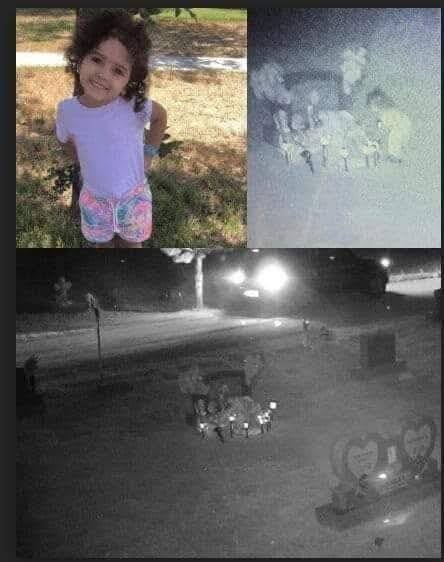
In Las Cruces, New Mexico, the Masonic Cemetery has long been a place where families visit, grieve, and remember. But in recent years, one story has risen above the rest — a story that began not with legend, but with a camera, a grieving family, and a moment that no one expected to witness. At the center of this story is Faviola Nova Rodriguez, a little girl who passed away at just two years old. She was laid to rest in the same cemetery where generations of families have been buried, her grave often adorned with toys, flowers, and small tokens of remembrance. Her short life and tragic passing left a deep mark on her family and community. What happened next is what brought her name into the wider public conversation. The story began when a family with a nearby grave noticed that items left for their loved one were being disturbed. Believing someone might be vandalizing the site, they set up a security camera to monitor the area overnight. What the camera captured became the center of a community-wide conversation. Across multiple news reports and social media posts, people described the same scene- a small child‑shaped figure walking through the cemetery in the middle of the night, the figure pausing at graves, lingering near toys and memorial items, movements that looked gentle, curious, and unmistakably childlike, a moment where the figure appeared to interact with toys left at one particular grave. When the footage was shown to a cemetery worker, they remarked that the figure resembled Faviola Nova Rodriguez — the same little girl buried only a short distance away. Her mother was later shown the video. She, too, said the figure looked like her daughter. Local news outlets picked up the story, sharing the footage.
The Myrtles Plantation


The Myrtles Plantation in St. Francisville, Louisiana, is one of the most famously haunted homes in the United States—a place where folklore, tragedy, and ghost stories intertwine with Southern Gothic charm. Built in 1796 by General David Bradford, the plantation is steeped in antebellum history and surrounded by moss-draped oaks. The house is said to be home to at least 12 ghosts, with countless reports of paranormal activity from visitors and staff. One of the most chilling legends involves a mirror in the main hallway. According to lore, after the murder of Sara Woodruff and her children, their spirits became trapped in the mirror because it wasn’t covered during mourning—a Southern tradition meant to prevent souls from getting stuck. Visitors claim to see handprints, faces, and strange smears that reappear even after cleaning. Paranormal investigators have reported cold spots and unexplained reflections, adding to the mirror’s haunted reputation. The grand staircase is another hotspot for ghostly sightings. Many claim to see the ghost of Chloe, a former enslaved woman allegedly involved in the poisoning of the Woodruff family. Her spirit is said to linger near the stairs. A famous photo taken in the 1990s allegedly shows a shadowy figure standing on the staircase, which some believe is Chloe. Guests have reported phantom footsteps, whispers, and a feeling of being watched while ascending or descending the stairs.
Fateful Fall
In May 1942, photojournalist, Russell Sorgi captured a chilling moment outside the Genesee Hotel in Buffalo, New York: Mary Miller, mid-fall, having leapt from the eighth-story window.
The image, frozen just seconds before her death, stunned the nation with its stark immediacy. Reprinted in Life magazine weeks later, it became one of the most haunting and widely recognized photographs of its time—an enduring testament to the power of photojournalism to arrest time and evoke deep, uncomfortable truths.


Deja Vu
You know that eerie feeling, when something completely new feels strangely familiar? Scientists are now giving déjà vu a mind-bending twist. A new theory suggests it could be more than a brain glitch. It might be a momentary crossover between you and your parallel self in another universe.
According to this idea, déjà vu occurs when two versions of you existing in slightly different realities, briefly align. The same event happens in both worlds at once, and your consciousness flickers between them. That flicker feels like recognition, a whisper from another life where you’ve already lived that instant.
Some researchers link this to quantum entanglement, where particles remain connected across space and time. If the universe is a vast network of probabilities, déjà vu might be a signal of those threads momentarily syncing. Others argue it’s the brain’s way of processing overlapping memories — but even that doesn’t explain why it feels so profoundly real.
Imagine each déjà vu as a cosmic glitch a second of alignment where the boundaries between universes blur just enough for you to sense another version of yourself watching the same moment unfold. Maybe déjà vu isn’t confusion. Maybe it’s confirmation that reality isn’t as linear as we think.